
 |
350th squadron ( BAF)" Ambiorix" |
 |
350 sqn " Ambiorix" ( BAF) | |||
| Status: |
Active
|
|||
| Version: | F-16A/B block 20 MLU | |||
| Role: | Multirole | |||
| Tailband: | N/A | |||
| Motto: | Belgae Gallorum Fortissimi (The Belgians, bravest of the Gauls) | |||
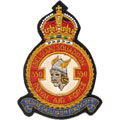
| Badge: | An ancient Belgian warriors head with the motto at the bottom and the British crown on top. | |||
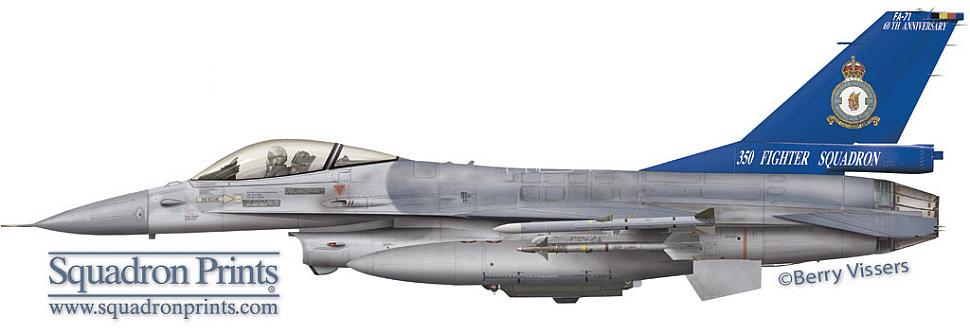
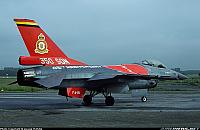
Sideways profile for 350 sqn in 2001 with the 60 years anniversary tail.
F-16 History
On March 3rd, 1980, 350 squadron started its conversion on the F-16 and became operational on January 1st, 1982. The squadron's pilots took part in many exercises: air firing training at Solenzara (Corsica), several DACT (Dissimilar Air Combat Training), as well as international exercises. The best-known are the ACMI (Air Combat Maneuvering Instrumentation) at Decimomanu and in the North Sea, the American Red Flag, the TLP (Tactical Leadership Program) and the Canadian Maple Flag.
In 1993, the "Armed Forces Restructuring Plan" of Minister Delcroix imposed drastic budget cuts on the Belgian Air Force. The disbanding of the 1st Fighter Wing occurred at the beginning of 1996 with 350 squadron leaving Beauvechain and moving to Florennes joining the 2nd Tactical Wing on March 4th, 1996.
Reduced to 12 aircrafts (instead of 18), like the other squadrons of the Air Force, it was quartered with the QRA at the 2nd Tactical Wing at Florennes AB and ensured this role with the other fighter squadrons. Besides its participation in the Central Europe air defence system, 350 squadron was assigned to the Rapid Reaction Forces and may be required to deploy at a very short notice on NATO's orders.
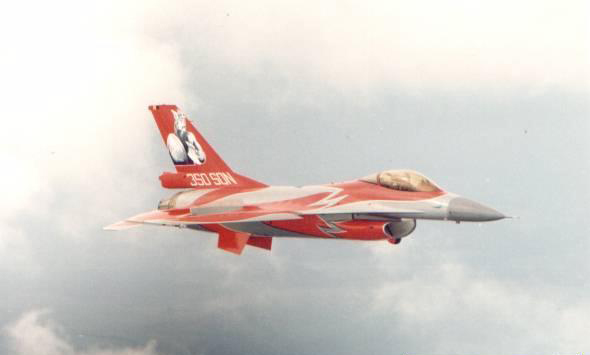
The 350th squadron ensures air defence missions. But it could be found to ensure conventional offensive missions in support of peacekeeping operations if it needs to be.
A new restructuring plan took place with the project 'Falcon 2000'. The decision was taken to disband the 2nd squadron in 2001. This resulted in the fusion of both squadrons under the 350th squadron, which integrated all the personnel of former 2nd squadron.
In late 2003 the Belgian government announced a further reduction of the F-16 fleet as part of a cost reducing effort for the armed forces. This will mean that 350 squadron will loose 1/3rd of their F-16s again and will keep 12 planes operational in 2015.
Aircraft Markings History
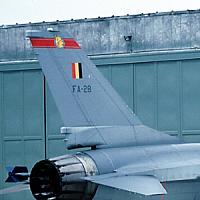
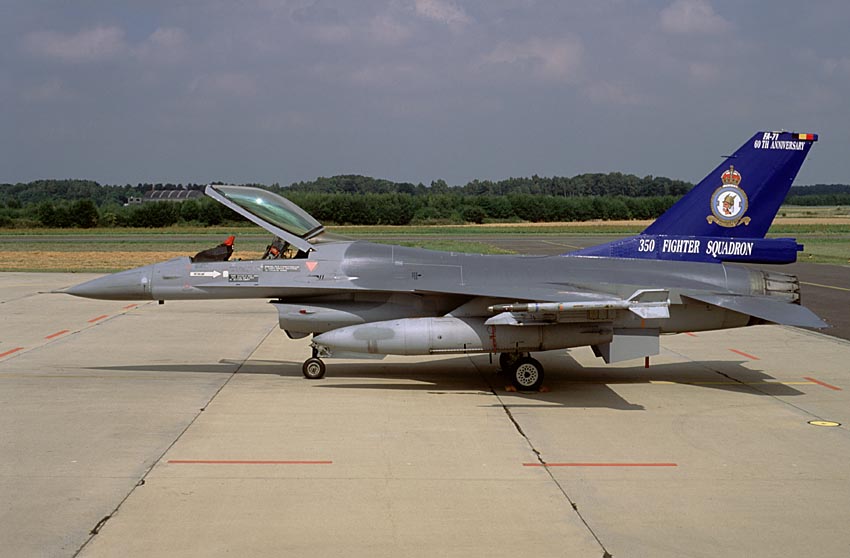
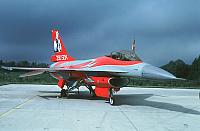
A red tailband with the squadron's logo adorned the F-16s in this timeframe.
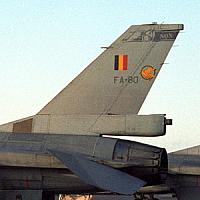
The tailband was retained but executed in a toned-down format with '350 sqn' titles added on each end of the logo. The logo of the 1st Wing was also added on the rudder.
The tailband was changed to the wild boar's head of the 2nd Wing. An 'FS' tail code for Florennes AB was added in the center of the tail. This was only a temporary marking that wasn't painted on all aircraft and ultimately wasn't accepted by the Air Force staff.
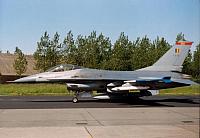
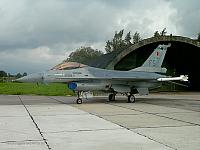
All squadron logos of the Belgian F-16s have been removed after the MLU conversion.
Unit History
- 1941: Activation of the squadron in Valley (UK)
- 1941: 'Spitfire' Mk. IIA
- 1942: 'Spitfire' Mk. VB
- 1942: 'Spitfire' Mk. VC
- 1943: 'Spitfire' Mk. IXB
- 1944: 'Spitfire' Mk. IX
- 1944: 'Spitfire' Mk. XIV
- 1945: 'Spitfire' Mk. XIV (part of 123 Wing (RAF), Wunstorf [Germ.])
- 1945: 'Spitfire' Mk. XIV (part of 135 Wing (RAF), Fassberg [Germ.])
- 1946: 'Spitfire' Mk. XIV (part of 160 Wing, Fassberg [Germ.])
- 1946: 'Spitfire' Mk. XVI (part of A Wing, Beauvechain)
- 1947: 'Spitfire' Mk. XIV (part of 160 Wing)
- 1948: 'Spitfire' Mk. XIV (part of 1 Wing)
- 1949: 'Meteor' F. Mk. 4
- 1951: 'Meteor' F. Mk. 8
- 1957: 'Hunter' Mk. 4
- 1958: CF-100 Mk. 5 'Canuck'
- 1963: F-104G 'Starfighter'
- 1980: F-16A 'Fighting Falcon'
- 1996: F-16A 'Fighting Falcon' (part of 2 Wing, Florennes)
- 2000: F-16AM 'Fighting Falcon'
Deployments
 |
' Decisive Endeavour' |
| Villafranca AB, Italy (start operation to December of 1996) | |
| From the start of the Belgian Air Force F-16 operations in former Yugoslavia till December of 1996 it was part of 'Decisive Endeavour'. This was an operation in support of the UN-led IFOR troops stationed in Bosnia-Herzegovina. | |
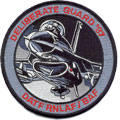 |
' Deliberate Guard' |
| Villafrance AB, Italy (December of 1996 to June 20th, 1998) | |
| When the UN forces in Bosnia-Herzegovina changed their mandate resulting in a name change from IFOR to SFOR, also the air operations were given another name. Ultimately, 'Deliberate Guard' formed the air asset for the SFOR troops. | |
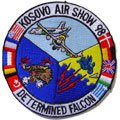 |
' Determined Falcon' |
| Villafranca AB, Italy (June 15th, 1998 to June 16th, 1998) | |
| Operation 'Determined Falcon' was a one-day operation to show force over Kosovo and Albania. NATO fighters patrolled this airspace coming only within 10nm of Serbian territory. This operation was meant as a warning to Serbian politicians to stop the bloodshed in this Yugoslavian province. | |
 |
' Deliberate Forge' |
| Amendola AB, Italy (June 20th, 1998 to end operation) | |
| Operation 'Deliberate Forge' was the successor of operation 'Deliberate Guard'. When the SFOR troops were reorganised into a smaller force, the covering air campaign also received a new name. This operation continued until the end of Belgian Air Force operations in Yugoslavia, which ended in the summer of 2001. | |
 |
' Allied Force' |
| Amendola AB, Italy (March 23rd, 1999 to June 10th, 1999) | |
| Operation 'Allied Force' was the codename for the almost three month long air strikes against Serbia. 350 sqn wasn't yet equiped with the MLU F-16 and only flew air support sorties during the conflict. | |
 |
' Air Policing Baltic States' |
| Siauliai AB, Lithuania (March 30th, 2004 to June 30th, 2004) | |
| This operation started when Lithuania, Estonia and Latvia joined NATO. These countries don't have fighters themselves and rely upon NATO for their air coverage. In a three-month rotation Belgian F-16s will patrol the skies over the Baltic States. | |
 |
' ISAF - Eastern Eagle' |
| Kabul AB, Afghanistan (July 14th, 2005 to January 14th, 2006) | |
| As a reinforcement for the ISAF air asset, the Belgian government decided to station 4 F-16s at Kabul AB together with the same number of Dutch aircraft to secure the parliamentary elections of September 2005. The initial four-month deployment was eventually extended to 6 months. | |
 |
' Air Policing Baltic States' |
| Siauliai AB, Lithuania (December 1st, 2006 to March 31st, 2007) | |
| This is the second deployment of the Belgian Air Force to the three Baltic states (Lithuania, Estonia and Latvia). This time a four-month rotation will see the Belgian F-16s patrol the skies over the Baltic States. | |
 |
' ISAF - Guardian Falcon' |
| Kandahar AB, Afghanistan (September 1st, 2008 to December 31st, 2008) | |
| In the summer of 2008 the Belgian government decided to step up and Join the NATO effort in Afghanistan with F-16 fighters. A total of 4 fighters were dispatched who strenghtened the Dutch contingent. The Belgian operation was called Guardian Falcon. | |
 |
' ISAF - Guardian Falcon' |
| Kandahar AB, Afghanistan (September 1st, 2009 to April 30th, 2010) | |
| This marked the second deployment of the squadron in the Guardian Falcon rotational deployments. By this time the detachment had risen to 6 aircraft being deployed. | |
 |
' ISAF - Guardian Falcon' |
| Kandahar AB, Afghanistan (January 1st, 2011 to August 31st, 2011) | |
| This marked the third consequitive deployment to Afghanistan for the unit. This was part of OGF VIII and IX. | |
 |
' Odyssey Dawn / Unified Protector' |
| Araxos AB, Greece (March 23rd, 2011 to October 31st, 2011) | |
| During the units' stay in Afghanistan the situation in Libya got very hot. During the latter part of the deployment personnel returning from Afghanistan were already dispatched to Greece with a number of aircraft also sent there to relieve units of the 10th Wing. This was a very busy period for the squadron. | |
|
|
' ISAF - Guardian Falcon' |
| Kandahar AB, Afghanistan (January 1st, 2012 to April 30th, 2012) | |
| OGF XI was a shorter deployment of the squadron. This was done to relieve the sisterunit of the 10th Wing a little relieve since their busy deployment schedule. | |
|
|
' ISAF - Guardian Falcon' |
| Kandahar AB, Afghanistan (January 1st, 2013 to August 31st, 2013) | |
| Another rotation into Afghanistan. These missions are always conducted together with the sister squadron, the 1st. | |
|
|
' Air Policing Baltic States' |
| Siauliai AB, Lithuania (September 3rd, 2013 to January 2nd, 2014) | |
| This marked the third deployment of the Belgian Air Force to the Baltic states. Yet again a rotation in Afghanistan was followed by a another deployment keeping the high rythm of missions. | |
|
|
' ISAF - Guardian Falcon' |
| Kandahar AB, Afghanistan (May 1st, 2014 to August 31st, 2014) | |
| This marked the final rotation of the squadron into Afghanistan as the mission was set to close later in the autumn of 2014. | |
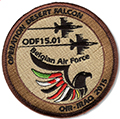 |
' OIR - Desert Falcon' |
| Al Azraq AB, Jordan (September 26th, 2014 to June 30th, 2015) | |
| The first rotation to fight against DAESH - IS. This rotation was executed with 6 F-16s coming from all 4 Belgian squadrons changing pilots and ground personnel over the entire deployment period. | |
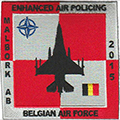 |
' Enhanced Air Policing' |
| Malbork AB, Poland (January 3rd, 2015 to August 31st, 2015) | |
| From 2015 onwards the number of locations for air policjg in Eastern Europe was expanded not only to include the Baltic States. Belgium sent 6 F-16s and a crew of 120 to support this mission. Al 4 squadrons rotated into Poland. |
F-16 Airframe Inventory
- All 350 sqn F-16s in our F-16 Aircraft Database (past and current aircraft)
- Current 350 sqn F-16s in our F-16 Aircraft Database
Photos
Please use this form to add any list any error or omissions you find in the above text.
Note: your comments will be displayed immediately on this page. If you wish to send a private comment to the webmasters, please use the Contact Us link.