
 |
149th Fighter Squadron ( USAF ANG) |
 |
149 FS ( USAF ANG) | |||
| Status: |
Converted
|
|||
| Version: | F-16C/D block 30 (small mouth) | |||
| Role: | Air Defense, Attack | |||
| Tailband: | Red & White & Blue | |||
| Motto: | N/A | |||
| Badge: | N/A | |||
|
As of September 16th, 2007 moved to Langley AFB and gained no aircraft, but work along side active unit F-22 crew.
|
||||
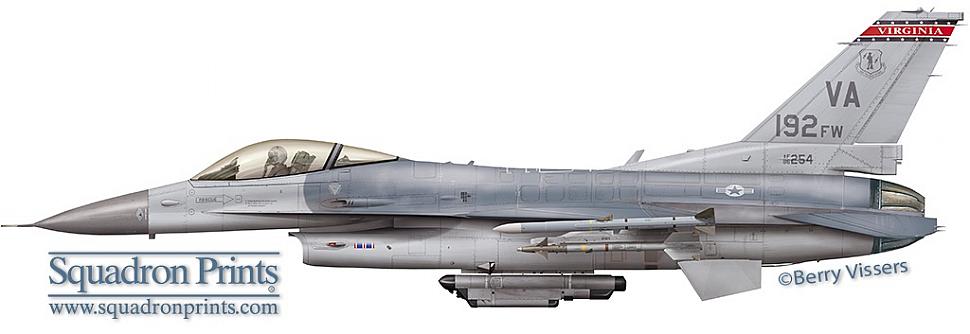
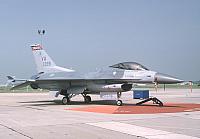
Sideways profile for the 149th FS in 1994 with unit markings on the tail.
F-16 History
In the years 1991 and 1992 the 149th TFS converted from the A-7D/K to the F-16C/D block 30. To get ready for the F-16 the squadron had a $ 2 million hush house built to test engines. Many guard units have spectacular markings with interesting stories to go with them. Of these, the story of how the 149th FS markings were attended is certainly unique. A modeler with the knowledge that the 149th FS was going to convert from the A-7 to the F-16 constructed a 1/32 scale model of the aircraft but had no idea of markings. Instead this modeler was very creative and adapted his own. Influential members of the parent 192nd FW were so impressed with the markings that they were adopted onto the real aircraft. The model aircraft was put on display at the entrance of the main operations building at Richmond. Since the closure of the base it is unknown what happened to this display model.
At first the squadron was assigned 24 aircraft. By early 1994 those numbers were lowered due to budget cuts. At first, cuts put them at 18 aircraft and then eventually 15 aircraft. The problem faced by many units with these cutbacks was that the same amount of aircraft still had to be maintained for operational readiness. In February of 1995 the unit was tasked with testing a concept in engine repairs. Air Combat Command directed that for the next 18 months the units engine department would be responsible for not only its own unit but also for the F-16s assigned to Pope AFB. Both the 149th FS and the 74th FS from Pope used the General Electric F110-GE-100 engine. It was Air Combat Commands intention to make engine repair more economical by having one location thus eliminating duplication of resources and equipment.
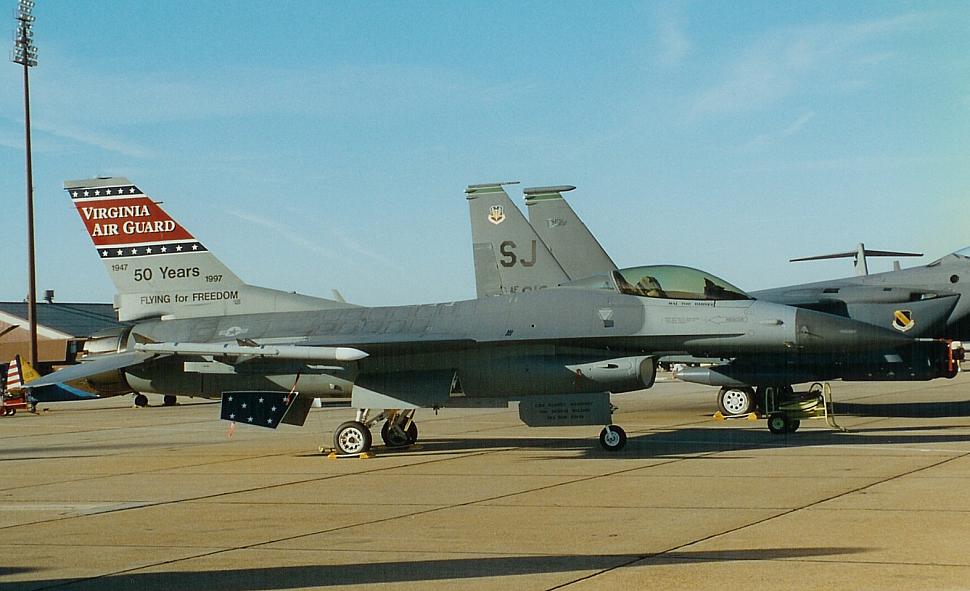
Also during 1995 the 149th FS was assigned something that caught a lot of people’s attention in the military and industry. With the retirement of the RF-4C lack of reconnaissance was left. At the time leading up to the RF-4C retirement, it was felt by the Air Force to discontinue manned reconnaissance operations. This thinking changed and the 149th FS became the center of attention when it began testing operational use of portable reconnaissance pod. The pod was built by Lockheed Martin and was delivered in only five months after being given the contract. Two more were delivered shortly after. In the pod is a digital camera that can take 2.5 frames per second and can store about 12,000 images. In order for the Virginia ANG F-16s to carry the pod, some modifications were needed. At the time, the block 30's did not have GPS which were added on the ammo drum cover. The GPS provided info to the recce pod only. First aircraft to be modified was #85-1572 and special markings were applied to the tail. Deemed operation with the recce pod by April of 1996 no time was wasted and the 149th FS was sent to Aviano AB in May of 1996. With war raging in Bosnia the 149th flew for 45 days with the recce pod. All this on the heels of an ONW deployment to Incirlik AB in February of the same year.
In the summer of 1998 the 149th FS upgraded its recce pods to the Theater Airborne Reconnaissance System (TARS) an upgraded version of what they already operated. Four other ANG units were also equipped with TARS. Later on datalink capabilities were upgraded allowing the recce pod to provide a live feed. On January 30th, 2001 the 149th FS had a near disaster when two of their F-16s collided in midair. It involved F-16C #86-0228 and F-16D #85-1572. Fortunately both aircraft landed safely. However F-16D #85-1572 was heavily damaged. Two years of repairs put the aircraft back into the air again.
Starting in 2006 the 149th FS began an unusual change. The F-16s were being taken away from Richmond and the squadron would be moving down the road to Langley AFB which is still within Virginia. Although the 149th FS would still exist under the same Fighter Wing it would own no aircraft. With a new assignment the 192nd FW would operate side-by-side with the 1st FW F-22 squadrons. This caused a mixed reaction. Some people were looking forward to working with the latest aircraft in the USAF inventory. Experienced crew were not as fond of getting away from the more relaxed atmosphere of the ANG. This coupled with a longer drive to work resulted in a few quitting or looking to join the 121st FS which still flew the F-16 in the nearby DC ANG. Personnel that did stay with the 192nd FW quickly showed the active duty units just how skilled the ANG can be. On June 12th, 2007 the squadron flew its last sortie with the F-16 and shortly after a ceremony and celebration was held to mark the end of F-16 operations in Richmond. The last F-16 (#86-0219) flew out on September 18th, 2007.
Aircraft Markings History
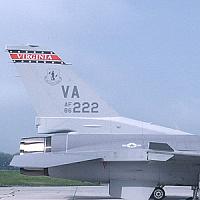
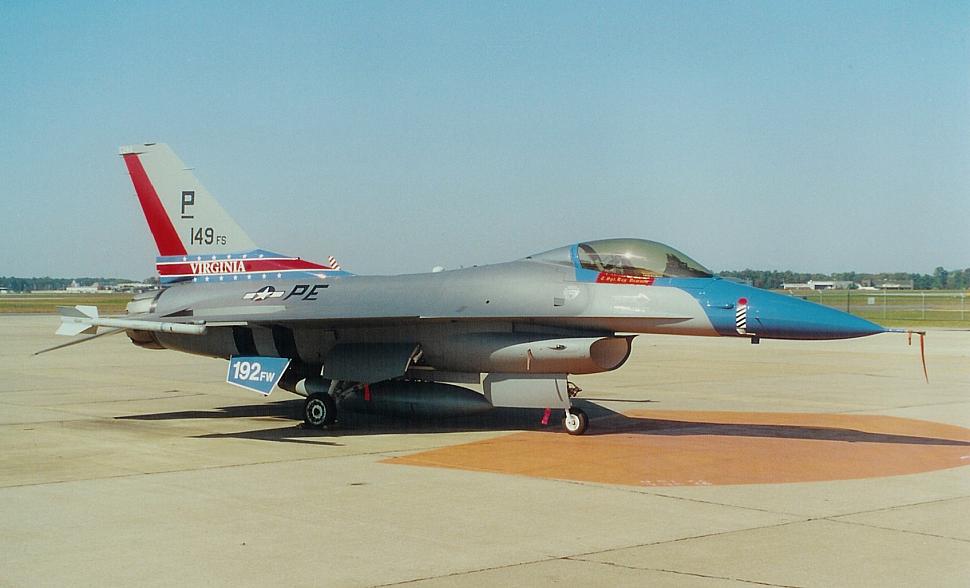
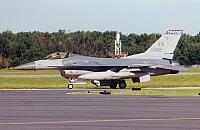
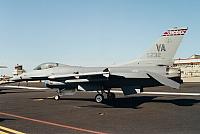
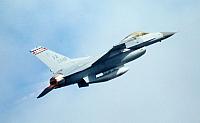
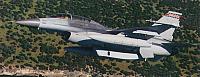
Tail markings were designed by a scale plastic modeler who designed his own markings as none had been applied on any aircraft at the time. The squadron liked the design so much that they adopted the markings from the model. The tail features two dark blue stripes around one red stripe with white 'Virginia' titles included on the tail tip. The blue stripe has white stars. The tailcode 'VA' is an obvious and appropriate initial of the state of Virginia in the centar of the tail with the serial number beneath it and the ANG logo between the tailcode and tailband.
Unit History
- 1942: Activation of the squadron in Bradley, Connecticut (as 328 FS)
- 1942: P-47B 'Thunderbolt' (part of 352 FG)
- 1942: P-47B 'Thunderbolt' (Mitchell Field, New York)
- 1942: P-47B 'Thunderbolt' (Westover Field, Massachusetts)
- 1943: P-47B 'Thunderbolt' (Trumbull Field, Connecticut)
- 1943: P-47B 'Thunderbolt' (Camp Kilmer, New York)
- 1943: P-47B 'Thunderbolt' (Bodney [Eng.])
- 1944: P-51B 'Mustang'
- 1944: P-51C 'Mustang'
- 1944: P-51D 'Mustang'
- 1945: P-51D 'Mustang' (Chièvres AB [Bel.])
- 1945: P-51K 'Mustang' (Bodney [Eng.])
- 1944: P-51K 'Mustang' (Camp Kilmer, New York)
- 1945: Deactivated
- 1946: Activation of the squadron in Richmond, Virginia (as 149 FS)
- 1946: P-47D 'Thunderbolt' (part of 192 FG)
- 1952: B-26 'Invader' (part of 192 BG)
- 1957: F-84F 'Thunderstreak' (part of 192 FIG)
- 1962: F-84F 'Thunderstreak' (part of 192 TFG)
- 1971: F-105D/F 'Thunderchief'
- 1981: A-7D/K 'Corsair II'
- 1991: F-16C/D 'Fighting Falcon'
- 1992: F-16C/D 'Fighting Falcon' (part of 192 FG)
- 1995: F-16C/D 'Fighting Falcon' (part of 192 FW)
- 2007: Converted
Deployments
 |
' Provide Comfort II' |
| Incirlik AB, Turkey [2 F-16s] (December 4th, 1993 to January 15th, 1994) | |
| The squadron was part of a rainbow deployment with three other block 30 ANG units. These units were the 120th FS, 174th FS and the 175th FS which all together took eleven aircraft. | |
|
|
' Provide Comfort II' |
| Incirlik AB, Turkey (January 9th, 1996 to April 9th, 1996) | |
| This marked the second deployment for the squadron in Turkey to fly missions in support of safeguarding the Kurds in northern Iraq. | |
 |
' Decisive Edge' |
| Aviano AB, Italy (May of 1996 to June of 1996) | |
| Operation Decisive Edge began on December 22nd, 1995 and was a follow-on to Operation Deny Flight. The operation was a United Nations mandated no-fly zone for the airspace over Bosnia-Herzegovina. On December 21st, 1996 Operation Decisive Edge transitioned to Deliberate Guard. The squadron purely deployed in a recce role with the newly recce pod. | |
 |
' Southern Watch' |
| Prince Sultan AB, Saudi Arabia (December of 2000 to February of 2001) | |
| Operation Southern Watch was an operation which was responsible for enforcing the United Nations mandated no-fly zone below the 32nd parallel in Iraq. This mission was initiated mainly to cover for attacks of Iraqi forces on the Iraqi Shi’ite Muslims. | |
 |
' Iraqi Freedom' |
| Al Udeid AB, Qatar (September of 2003 to October 20th, 2003) | |
| The 149th FS sent about 300 people and equipment to Iraq as part of the continuing campaign to liberate Iraq. This was the lead unit in a rainbow deployment which also involved aircraft and crew from the 138th FS from Syracuse, New York. Two incidents occured during the deployment. One was an EPU safety pin that wasn't removed prior to the flight and wasn't discovered till the aircraft reached the tanker. That aircraft had to return to base immediately. The second occurance was a blown seal and the pilot, from the 138th FS, elected to emergency land in Pakistan. It was found to be a good move as the plane would have likely not made it back to Qatar. Most of the 149th FS returned on October 20th, 2003 but the aircraft were left behind for the 138th FS portion of the deployment. Around ten to fifteen crew remained behind to help the 138th FS. |
F-16 Airframe Inventory
- All 149 FS F-16s in our F-16 Aircraft Database (past and current aircraft)
- Current 149 FS F-16s in our F-16 Aircraft Database
Photos
Related Info
Moved to Langley AFB, Virginia as an associate unit with the F-22A of the 1st FW but will own no aircraft.
Sources
Please use this form to add any list any error or omissions you find in the above text.
Note: your comments will be displayed immediately on this page. If you wish to send a private comment to the webmasters, please use the Contact Us link.