
 |
331st skvadron ( RNoAF)" Lion" |
 |
331 skv " Lion" ( RNoAF) | |||
| Status: |
Converted
|
|||
| Version: | F-16A/B block 20 MLU | |||
| Role: | Multirole | |||
| Tailband: | N/A | |||
| Motto: | For Norge (For Norway) | |||
| Badge: | Two crossed swords on a blue background. | |||
|
Converted to the F-35A on January 6th, 2022.
|
||||
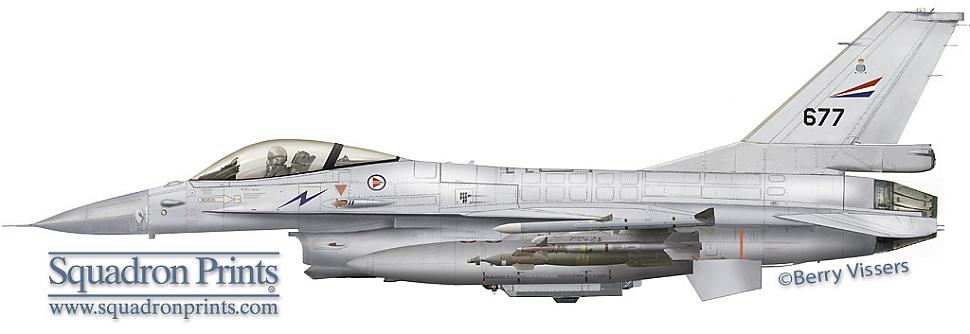
Sideways profile for 331 skv in 2005.
F-16 History
As in the majority of NATO countries the F-16 was the successor of the F-104G Starfighter. This was also the case with 331 skv. Operating from Bodø AB, the unit’s main task was to protect Norway against Soviet attacks. This meant that the squadron was also responsible for the defence of the northern NATO flank against these attacks and in case of a conflict it had to prevent Soviet aircraft flying through the Norway-Iceland gap and attack a NATO maritime fleet in the Atlantic.
Therefore the squadron was the first within the RNoAF to receive the F-16 and was declared operational for NATO duty in mid 1982. Because of the specific arctic nature of Bodø AB, the Norwegian F-16s were the first to be equipped with the extended tail house fairing to accommodate a drag chute. This drag chute enables F-16s to operate from snow or ice-covered runways where wheel brakes are of little to no use. Secondly, one of the tactics of the RNoAF is to operate from small airports north of the arctic circle in times of crisis. These airports have short runways so a braking chute comes in very handy on these occasions.
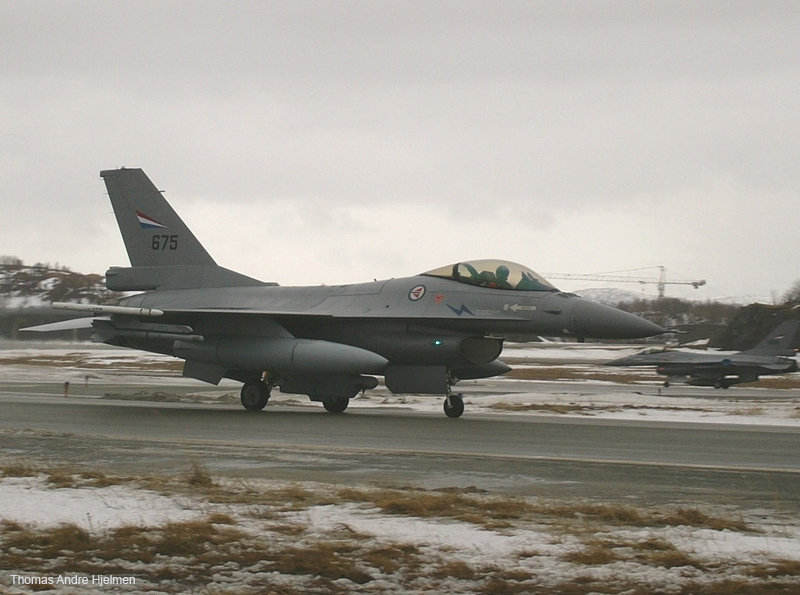
Another feature the Norwegians introduced on their vipers was an identification spotlight. This light serves to illuminate aircraft during interceptions at night. These tend to happen regularly over Norway, specially north of the arctic circle with its 4 months of complete darkness in wintertime. The search light is called a Russian light by the Norwegians.
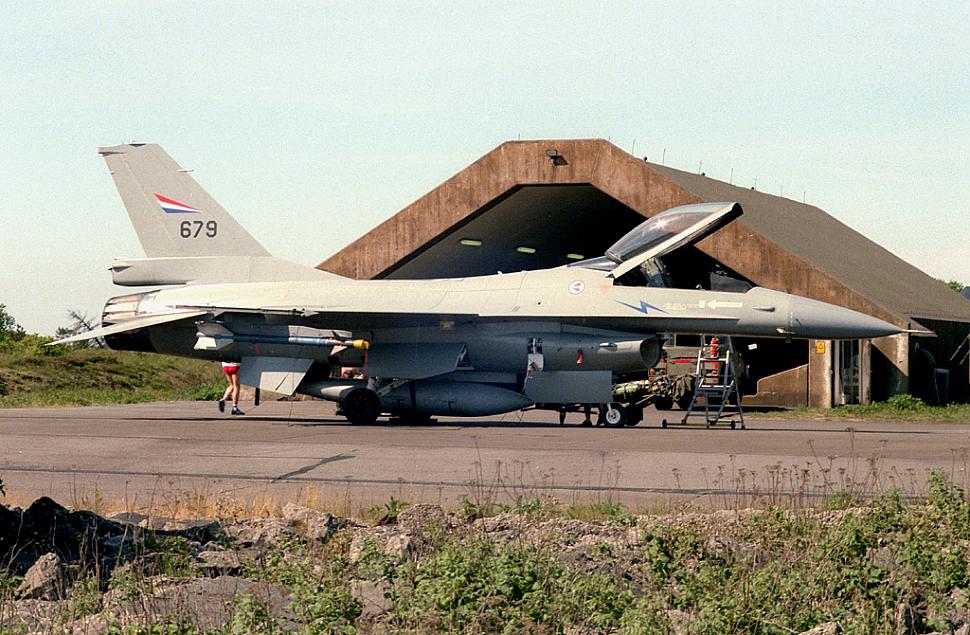
During the highlight of the Cold War an average of 200 interceptions were carried out by the squadron on a yearly basis. These have dropped dramatically since the disintegration of the Soviet Union. But still the squadron keeps two armed F-16s at QRA at all times.
With the introduction of the F-16 in the early eighties, all participating countries of NATO were responsible for the integration of an ECM system on the aircraft. Norway opted to install the AN/ALQ-162 system. This differs from the standard AN/ALQ-131 which is an external pod. The AN/ALQ-162 system is an internal system. This has the advantage of not taking up any external hard points.
Since the end of the Cold War and certainly with the introduction of the MLU version of the F-16, all squadrons are multi-role. However the main task of 331 skv stays with interception. With the introduction of the M2 software tape, the Norwegians decided to integrate the PANTERA targeting pod onto their F-16s. This vastly enlarges the possibilities of the F-16s in the attack role. More recently, the IRIS-T missile was acquired to replace the aging AIM-9. This missile takes advantage of the use of a Helmet Mounted Cueing System which was introduced on the F-16 with the M3/M4 upgrade.
Aircraft Markings History
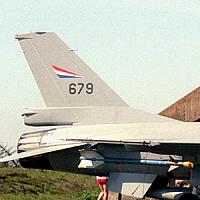
The tail marking consisted from the typical Norwegian forward facing triangle with three colors, being red, white and blue.
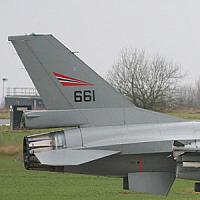
The triangle remained, but now features the colors of the FLO, being red and blue.
Unit History
- 1941: Activation of the squadron in Catterick (UK)
- 1941: 'Hurricane' Mk. I (RAF Castletown)
- 1941: 'Hurricane' Mk. I (RAF Skaebrae)
- 1941: 'Hurricane' Mk. IIB
- 1941: 'Spitfire' Mk. IIA
- 1942: 'Spitfire' Mk. VB (RAF North Weald)
- 1942: 'Spitfire' Mk. IXB
- 1943: 'Spitfire' Mk. IXB (part of 132 Wing (RAF))
- 1945: 'Spitfire' Mk. IXE (RAF Dyce)
- 1945: 'Spitfire' Mk. IXE (Gardermoen)
- 1949: 'Spitfire' Mk. IXE (Vaernes)
- 1951: Deactivated for one year
- 1952: F-84G 'Thunderjet' (Sola)
- 1955: F-84G 'Thunderjet' (Bodø)
- 1957: F-86F 'Sabre'
- 1963: F-104G 'Starfighter'
- 1981: F-16A 'Fighting Falcon'
- 2003: F-16AM 'Fighting Falcon'
- 2022: Converted
Deployments
 |
' Allied Force' |
| Grazzanise AB, Italy (March 23rd, 1999 to June 10th, 1999) | |
| Operation 'Allied Force' was the codename for the almost three month long air strikes against Serbia. It was the first time after WWII that Norway deployed fighters into operation. The aircraft were tasked with CAP mission since they didn’t send their new MLU aircraft. | |
 |
' Enduring Freedom' |
| Manas AB, Kyrgyzstan (October 1st, 2002 to March 31st, 2003) | |
| Operation 'Enduring Freedom' was initiated after the 9/11 attacks on the US. In Afghanistan this operation is aimed at fighting the remains of the Taliban which are still present in-country. | |
 |
' Air Policing Baltic States' |
| Siauliai AB, Lithuania (January 1st, 2005 to March 29th, 2005) | |
| This operation started when Lithuania, Estonia and Latvia joined NATO. These countries don't have fighters themselves and rely upon NATO for there air coverage. In a three-month rotation, Belgian, Danish, Norwegian and Dutch F-16s will patrol the skies over the Baltic States. | |
 |
' International Security and Assistance Force' |
| Kabul AB, Afghanistan (February 1st, 2006 to May 12th, 2006) | |
| The ISAF force is a NATO led operation to bring stability in Afghanistan and support of the local authorities. Also to protect ISAF ground forces. | |
 |
' Air Policing Baltic States' |
| Siauliai AB, Lithuania (December 16th, 2007 to March 14th, 2008) | |
| This is the second deployment of the Norwegian Air Force to the three Baltic states (Lithuania, Estonia and Latvia). This time a four-month rotation will see the Norwegian F-16s patrol the skies over the Baltic States. | |
 |
' Iceland Air Policing and Surveillance' |
| Keflavik AB, Iceland (2009) | |
| This marked the first deployment of Norwegian F-16s to Iceland for the patrolling mission. | |
 |
' Odyssey Dawn / Unified Protector' |
| Souda AB, Greece (March 23rd, 2011 to July of 2011) | |
| Norway sent 6 F-16s into theatre to help NATO with their mission over Libya. The Norwegians didn't stay untill the end of the campaign, but retracted their aircraft early during the summer months when less capacity was needed to end the conflict. | |
|
|
' Iceland Air Policing and Surveillance' |
| Keflavik AB, Iceland (2011) | |
| Right after the Libyan campaign the squadron was tasked with another trip to the chilly island of Iceland. | |
 |
' Iceland Air Policing and Surveillance' |
| Keflavik AB, Iceland (January 27th, 2014 to February 21st, 2014) | |
| With the third deployment the Norwegians are the main contributor to this NATO mission. Although the squadrons participating remain on alert for 4 months, the actual deployment only lasts between 3 and 4 weeks. |
F-16 Airframe Inventory
- All 331 skv F-16s in our F-16 Aircraft Database (past and current aircraft)
- Current 331 skv F-16s in our F-16 Aircraft Database
Photos
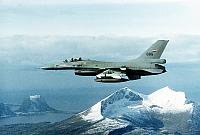
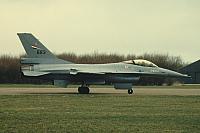

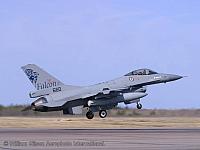
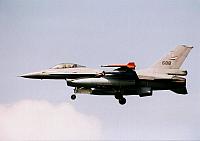
Special Thanks
Niels C. Boman
Please use this form to add any list any error or omissions you find in the above text.
Note: your comments will be displayed immediately on this page. If you wish to send a private comment to the webmasters, please use the Contact Us link.