
 |
121st Fighter Squadron ( USAF ANG)" Capital Guardians" |
 |
121 FS " Capital Guardians" ( USAF ANG) | |||
| Status: |
Active
|
|||
| Version: | F-16C/D block 30 (big mouth) | |||
| Role: | Air Defense, Attack | |||
| Tailband: | Red (with four stars) | |||
| Motto: | N/A | |||
| Badge: | N/A | |||
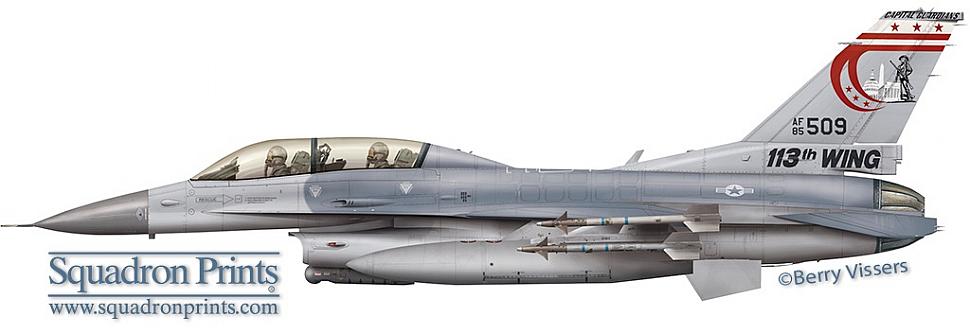
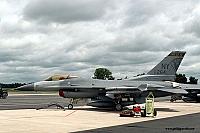
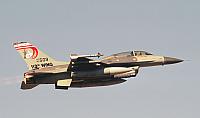
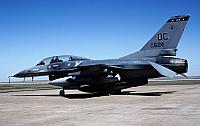
Sideways profile for the 121st FS in 2009 with unit markings on the tail.
F-16 History
The 121st FS started receiving their F-16s in September of 1989. These were block 5 and 10 models coming from various regular USAF units converting to more modern C/D models. In the late eighties and early nineties it was still a habit to transfer older aircraft types to the ANG with the regular USAF units receiving all the latest hardware. The main task of the unit was air defense and attack. Neither role the squadrons block 5 and 10 models were set out to do. In the air defense role these models lacked any BVR capability, limiting them only to close range combat with their gun and Sidewinder missiles. In the attack role these airframes were able to deploy bombs, but with their smaller stabs the center of gravity of these aircraft was far from ideal making it quite a challenge for the pilots to fly these missions.
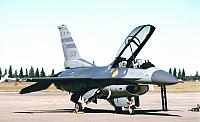
In 1994 this all changed with the introduction of newer small inlet block 30 models. The mission of the squadron remained unchanged, albeit their airframes were better suited to fly these missions. A BVR capacity became available and with the more modern APG-68 radar and other electronics these airframes are better suited for the attack role as well.
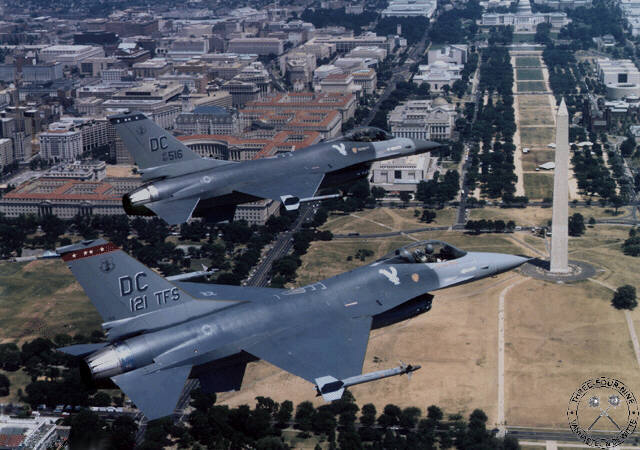
After the events of September 11th, 2001 the squadron took on an Air Sovereignty Alert Detachment role, stationing a number of airframes at air force bases around the country to fly alert missions. During one of those missions, on May 11, 2005 the squadron scrambled to intercept an aircraft that wandered into the no-fly zone around the White House. Customs officials had also scrambled a Black Hawk helicopter and a Cessna Citation jet at 11:47 a.m. to intercept the plane. The Customs aircraft gave way when the F-16s arrived flew on the wing tips of the little plane. They dipped their wings - a pilot's signal to ‘follow me’ - and tried to raise the pilot on the radio. But the Cessna didn't change course and it was flying too slow for the F-16s. The frustrated pilots had to take turns dropping flares, breaking away and returning to drop more flares. One senior Bush administration counterterrorism official said it was ‘a real finger-biting period’ because they came very close to ordering a shot against a general aircraft. Finally, when the Cessna came within three miles of the White House - just a few minutes flying time - it altered course.
On May 6, 2008 the squadron flew it's 2000 scramble since the events of September 11, 2012. Most scrambles do not lead to such stories as noted above.
The most recent change within the unit happened in 2010 when the squadrons airframes were exchanged for big mouth block 30 models coming from the 188th FS. The first airframe to arrive (#87-0227) touched down at Andrews on April 1st, 2010.
Aircraft Markings History
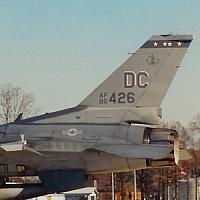
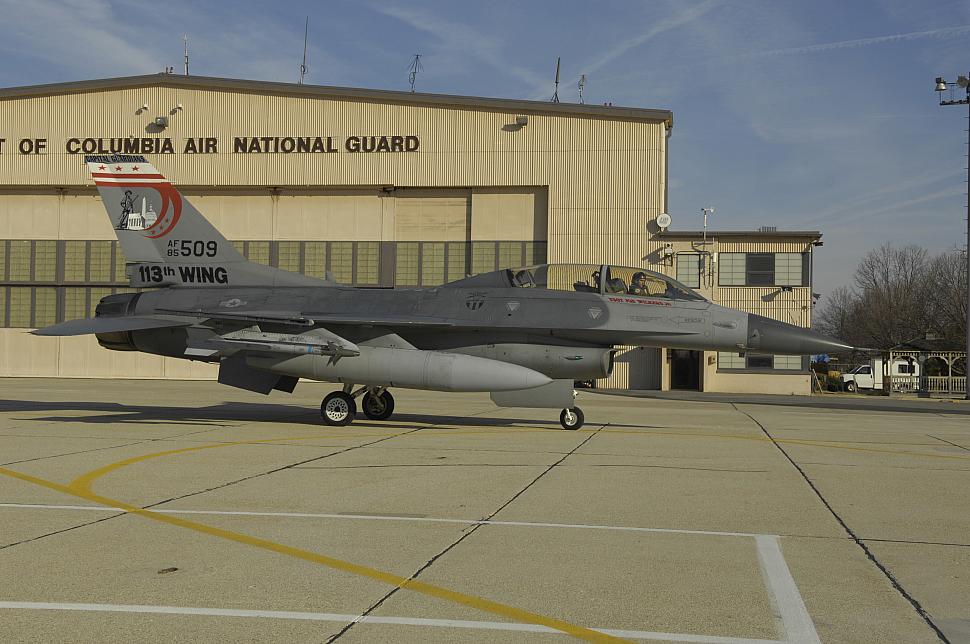
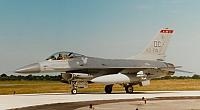
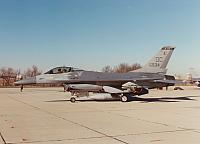
The tail consist of a red tailband (although the colored ones are only worn by the squadron and wing jets, the other jets are toned-down markings) with 4 white stars inside it grouped together into three sets to make the arrangement single-double-single to represent the squadrons number (121). The 'DC' tailcode is in the center of the tail with the serial beneath it and the ANG logo above.
Unit History
- 1940: Activation of the squadron in Boling, Washington DC
- 1940: O-38 (part of 65 OG)
- 1940: O-47 (simultaneous)
- 1940: O-52 'Owl' (simultaneous)
- 1941: O-52 'Owl' (Owens Field, South Carolina)
- 1941: O-52 'Owl' (Lexington AP, South Carolina)
- 1941: O-52 'Owl' (Langley Field, Virginia)
- 1942: O-52 'Owl' (Birmingham, Alabama)
- 1942: Deactivated
- 1943: Activation of the squadron in Vichy, Missouri
- 1943: RA-24B 'Banshee' (part of 76 RG)
- 1943: RA-24B 'Banshee' (Morris Field, North Carolina)
- 1943: RA-24B 'Banshee' (Raleigh-Durham Field, North Carolina)
- 1944: A-20 'Havoc' (Oran [Alg.])
- 1944: A-20 'Havoc' (Telergma [Alg.])
- 1944: A-20 'Havoc' (Pomigliano [It.])
- 1944: A-20 'Havoc' (Firenze [It.])
- 1944: A-20 'Havoc' (part of 9 AF)
- 1945: A-20 'Havoc' (part of 12 AF)
- 1945: A-20 'Havoc' (Verona [It.])
- 1945: A-20 'Havoc' (Manerba [It.])
- 1945: A-20 'Havoc' (Firenze [It.])
- 1945: UC-78 (part of 3 AF, Drew Field, Florida)
- 1945: UC-78 (Muskogee Field, Oklahoma)
- 1945: Deactivated
- 1946: Activation of the squadron in Andrews, Maryland
- 1946: P-47D 'Thunderbolt' (part of 113 FG)
- 1949: F-84C 'Thunderjet'
- 1951: F-94C 'Starfire' (part of 113 FIG, New Castle AFB, Delaware)
- 1952: F-51H 'Mustang' (Andrews AFB, Maryland)
- 1954: F-86A 'Sabre'
- 1955: F-86E 'Sabre'
- 1957: F-86H 'Sabre'
- 1958: F-86H 'Sabre' (part of 113 TFG)
- 1960: F-100C/F 'Super Sabre'
- 1968: F-100C/F 'Super Sabre' (Myrtle Beach AFB, South Carolina
- 1969: F-100C/F 'Super Sabre' (Andrews AFB, Maryland)
- 1971: F-105D/F 'Thunderchief'
- 1974: F-105D/F 'Thunderchief' (part of 113 TFW)
- 1981: F-4D 'Phantom II'
- 1989: F-16A/B 'Fighting Falcon'
- 1992: F-16A/B 'Fighting Falcon' (part of 113 FW)
- 1994: F-16C/D 'Fighting Falcon'
Deployments
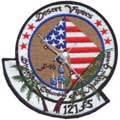 |
' Southern Watch' |
| Al Jaber AB, Kuwait (May of 1996 to July of 1996) | |
| The 121st FS was the first ANG unit to fly OSW. Operation Southern Watch was an operation which was responsible for enforcing the United Nations mandated no-fly zone below the 32nd parallel in Iraq. This mission was initiated mainly to cover for attacks of Iraqi forces on the Iraqi Shi’ite Muslims. | |
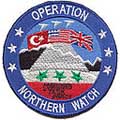 |
' Northern Watch' |
| Incirlik AB, Turkey (February of 1997 to April of 1997) | |
| Operation Northern Watch was a US European Command Combined Task Force (CTF) who was responsible for enforcing the United Nations mandated no-fly zone above the 36th parallel in Iraq. This mission was a successor to Operation Provide Comfort which also entailed support for the Iraqi Kurds. | |
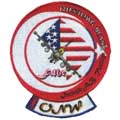 |
' Northern Watch' |
| Incirlik AB, Turkey (January 11th, 1998 to February 6th, 1998) | |
| This marked the second deployment in the Northern Watch cycle. This time the deployment was only for a month with less than 100 personnel being deployed. | |
 |
' Iraqi Freedom' |
| Unknown (March of 2003 to April 29th, 2003) | |
| This marked the first rotation in the AEF cycles the squadron had to perform. The squadron was immediately put to the test with the conflict starting in the same month they deployed into theatre with the invasion starting on March 19th. | |
 |
' Iraqi Freedom' |
| Balad AB, Iraq (August of 2006 to October of 2006) | |
| It was a long time since the squadron was deployed to the Middle East for a rotation. This was the first time the unit took the full period of three months. | |
|
|
' Iraqi Freedom' |
| Balad AB, Iraq (December 18th, 2009 to April 5th, 2010) | |
| This was a rainbow deployment with the 119th FS and 175th FS. Every unit deployed a number of airframes with crews of all squadrons flying and maintaining the F-16s. | |
 |
' Enduring Freedom' |
| Bagram AB, Afghanistan (October 13th, 2011 to April 14th, 2012) | |
| More than 175 members of the 113th Wing, District of Columbia Air National Guard deployed to Bagram Airfield, Afghanistan. Some members returned home during December of 2011, but most stayed longer. |
F-16 Airframe Inventory
- All 121 FS F-16s in our F-16 Aircraft Database (past and current aircraft)
- Current 121 FS F-16s in our F-16 Aircraft Database
Photos
Please use this form to add any list any error or omissions you find in the above text.
Note: your comments will be displayed immediately on this page. If you wish to send a private comment to the webmasters, please use the Contact Us link.