
Fighter Jet News
F-16 Fighting Falcon News
30 years of Norway F-16s
January 16, 2010 (by
Bjørnar Bolsøy) -
Norway celebrated 30 years of F-16 operations. On January 15 1980 test pilot Steinar Berg flew F-16B #78-0301 from the Fokker factory at Amsterdam-Schiphol in the Netherlands to Rygge AFB ushering in a new era for the arctic air force.
Within a few years the F-16 replaced the F-104 and most of the F-5s, which had served as the backbone of the RNoAF fighter force since the 1960s.
The 30 year anniversary was marked with an event at Rygge AFB Friday, with displays and formation flying by F-16s and various aircraft. In their speeches Secretary of State Espen Barth Eide and Secretary of the Air Force Stein Erik Nodeland emphasized the F-16's highly successful operational history and the importance of continuous modernizations to the fleet.
"Even though 30 years is a lot for an aircraft, the F-16 performs better than ever. It's a fantastic aircraft", noted Secretary of State Espen Barth Eide.
Despite their age - some of the airframes approaching 6000 flight hours - it's still a world class fighter. Since the mid 1990s the F-16s have gone through several modernization phases in collaboration with the U.S. Air Force and the European EPAF allies. Currently the fleet is upgrading to the M5 configuration and will continue to receive upgrades for the remainder of its service life. The oldest airframes will receive new wings to ensure operational effectiveness until the fleet's planned retirement around 2020.
332 Squadron chief Lt. Col. Øyvind Gunnerud recognized the F-16's service history as "exemplary". "This aircraft has been ground breaking", he noted. "It has provided us with an incredible amount of experience and it is important that we thank those who in the 1970s made the decision to bring this aircraft to Norway".
Eventually the RNoAF received 74 F-16s; 60 single seat F-16As and 14 of the twin seat F-16B, including two attrition replacements in the late 1980s. 57 aircraft remain in service today. The fleet has acquired close to 340.000 flight hours, averaging around 10.000 in recent years. Six crew and 17 aircraft have been lost in accidents, the last one in 2001, making it twice as safe as the types it replaced.
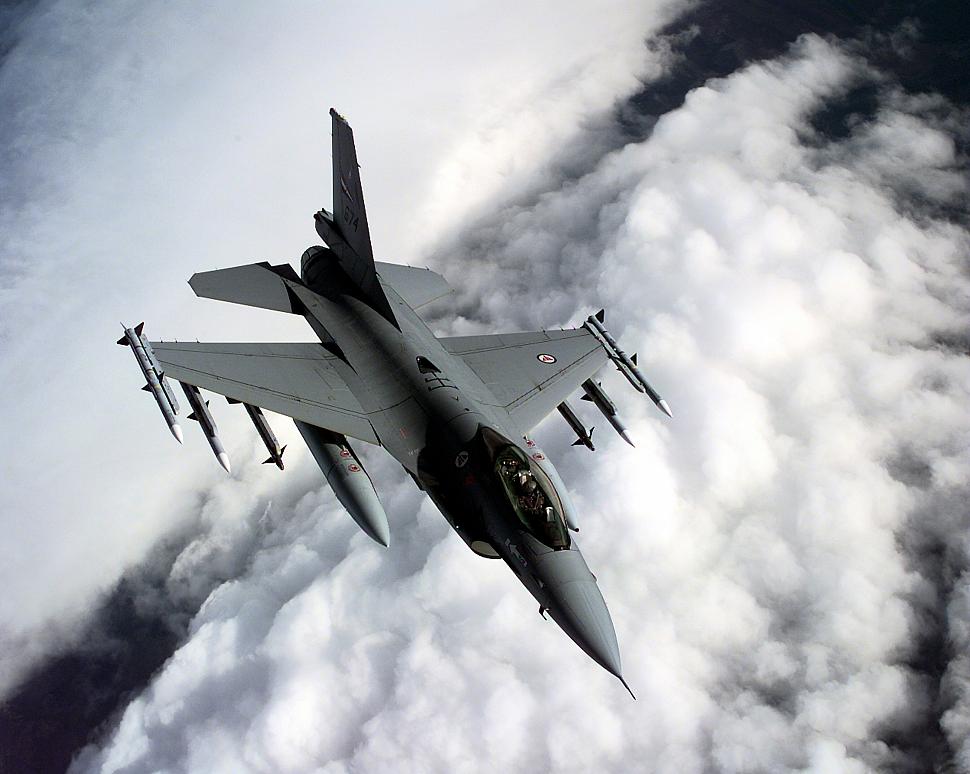
RNoAF F-16AM #674 drops away after refueling over the Balkan region from a USAF KC-135R from the 22nd ARW, in support of NATO Operation Allied Force. The Norwegian F-16A is loaded with AIM-9 Sidewinder and AIM-120 AMRAAM air-to-air missiles and has refueled to extend its loiter time and range during a Combat Air Patrol over the former Yugolavia. [USAF photo by SrA. Greg L. Davis]
The 30 year anniversary was marked with an event at Rygge AFB Friday, with displays and formation flying by F-16s and various aircraft. In their speeches Secretary of State Espen Barth Eide and Secretary of the Air Force Stein Erik Nodeland emphasized the F-16's highly successful operational history and the importance of continuous modernizations to the fleet.
"Even though 30 years is a lot for an aircraft, the F-16 performs better than ever. It's a fantastic aircraft", noted Secretary of State Espen Barth Eide.
Despite their age - some of the airframes approaching 6000 flight hours - it's still a world class fighter. Since the mid 1990s the F-16s have gone through several modernization phases in collaboration with the U.S. Air Force and the European EPAF allies. Currently the fleet is upgrading to the M5 configuration and will continue to receive upgrades for the remainder of its service life. The oldest airframes will receive new wings to ensure operational effectiveness until the fleet's planned retirement around 2020.
332 Squadron chief Lt. Col. Øyvind Gunnerud recognized the F-16's service history as "exemplary". "This aircraft has been ground breaking", he noted. "It has provided us with an incredible amount of experience and it is important that we thank those who in the 1970s made the decision to bring this aircraft to Norway".
Eventually the RNoAF received 74 F-16s; 60 single seat F-16As and 14 of the twin seat F-16B, including two attrition replacements in the late 1980s. 57 aircraft remain in service today. The fleet has acquired close to 340.000 flight hours, averaging around 10.000 in recent years. Six crew and 17 aircraft have been lost in accidents, the last one in 2001, making it twice as safe as the types it replaced.
Additional images:
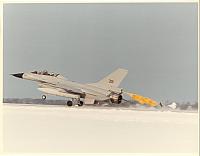
RNoAF F-16B block 1 #301 from 332 skv is seen landing and deploying its braking shoot at Rygge AB on January 28th, 1980. The aircraft was written off on November 13th, 1984 after a engine fire during take-off. [Photo by A. Van Haute]
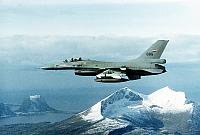
An AGM-119A Penguin anti-ship missile is mounted on the pylon of RNoAF F-16A block 15 #685 from 331 skv during testing of the missile in the mid eighties. [USAF photo]
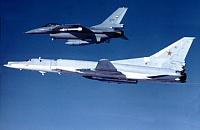
RNoAF F-16A block 5 #278 flying aside a Russian Tu-22M3 'Backfire-B' bomber in the mid eighties. The aircraft crashed on March 23rd, 1992. [Photo by FMS]
Related articles:
Forum discussion:
Tags
- Norwegian F-16s scramble to intercept Russian bombers (2007-07-20)
- Norwegian F-16s for ISAF in Afghanistan (2005-11-15)
- Norwegian F-16s protect Baltic states (2005-01-10)
- RNoAF losses of F-16 from 1981 till 2003 (2003-08-05)
- F-16 Fighting Falcon news archive
Forum discussion:
- Start a discussion about this article in the F-16.net forum.
Tags