
 |
176th Fighter Squadron ( USAF ANG)" Badgers" |
 |
176 FS " Badgers" ( USAF ANG) | |||
| Status: |
Active
|
|||
| Version: | F-16C/D block 30 (big mouth) | |||
| Role: | Attack | |||
| Tailband: | Red & White | |||
| Motto: | N/A | |||
| Badge: | N/A | |||
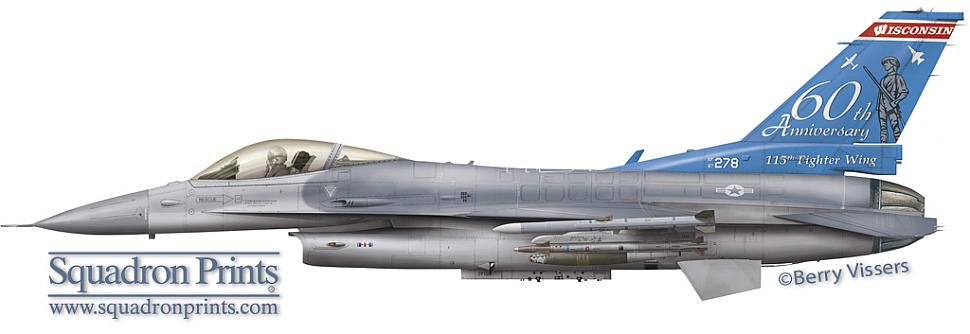
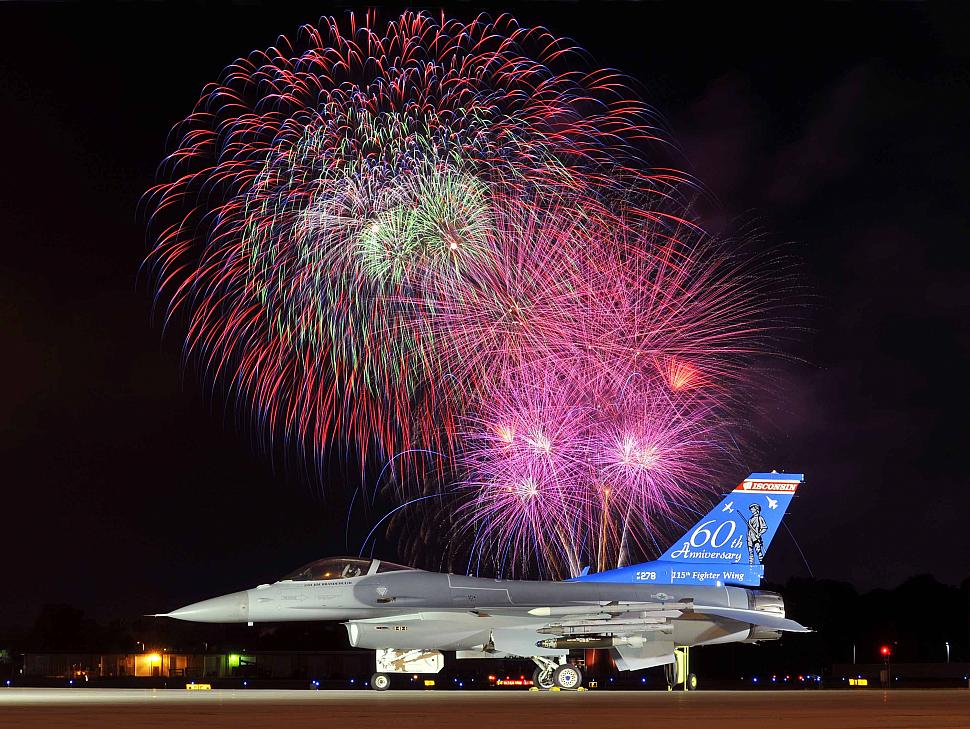
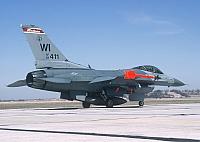
Sideways profile from the 176th FS in 2008 with the special 60th anniversary markings.
F-16 History
In 1993 the 176th FS began transitioning from the A-10A to the F-16C/D block 30 airframes with the enlarged inlet. The first vipers arrived on April 1st, 1993. The current role of the 176th FS is air-interdiction and close air support (CAS). This was the same task as when they flew the A-10. Although the transition to the F-16 meant a huge change in the overall execution of this mission when comparing the A-10 with an F-16.
In the late eighties a number of block 30 airframes were equipped with adapted electronics and weapon systems as a proposed A-16. This concept however never came through because of numerous shortcomings. However, the F-16 was used in a CAS role all together, although the aircraft itself is not specifically designed for it and some aircraft – as the A-10 – still do a better job at it. Still, the 176th FS performs this mission for almost 20 years now. Newer electronics have paved the way to use the F-16 much better in this role – with the addition of night vision goggles (NVG’s) or advanced targeting pods. This gives these aircraft front edge of operational capabilities.
One of the latest information is that the squadron should be changing its block 30 models with newer block models. The block 30 models have been in the air for around 25 years already, many of them stretching their airframe hours and reaching over 6,000 hours. This means these airframes are due for retirement in the next years. Final word hasn’t gotten around that this change is imminent, but it will be inevitable in the end.
Aircraft Markings History
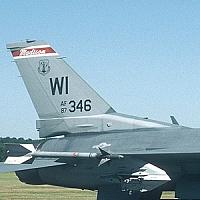
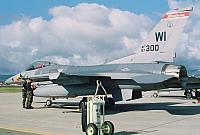
The tail consists of a red talband with white trimmings and white stenciling with 'Madison' titles inside it. The 'WI' tailcode is in the center of the tail with the serial beneath it and the subdued ANG logo between the tailcode and tailband.
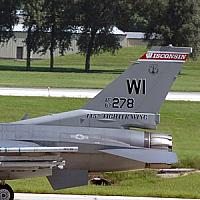
The general lay-out remained the same but the 'Madison' titles in the tailcode were replaced by 'Wisconsin' titles.
Unit History
- 1942: Activation of the squadron in Dale Mabry, Florida (as 306 FS)
- 1942: P-39 'Airacobra' (part of 338 FG)
- 1942: P-40 'Warhawk'
- 1943: P-47 'Thunderbolt'
- 1944: P-51 'Mustang'
- 1944: Deactivated
- 1946: Activation of the squadron in Truax, Wisconsin (as 176 FS)
- 1946: P-51D 'Mustang' (part of 128 FG)
- 1952: F-89A 'Scorpion'
- 1952: F-51H 'Mustang' (part of 31 AD)
- 1953: F-86A 'Sabre' (part of 128 FIW)
- 1955: F-89B/C 'Scorpion'
- 1957: F-89D 'Scorpion'
- 1959: F-89H 'Scorpion'
- 1960: F-89J 'Scorpion'
- 1965: (T)F-102A 'Delta Dagger'
- 1974: O-2A 'Skymaster' (part of 128 TASW)
- 1979: OA-37B 'Dragonfly'
- 1981: A-10A 'Thunderbolt II' (part of 128 TFW)
- 1992: A-10A 'Thunderbolt II' (part of 128 FW)
- 1993: F-16C/D 'Fighting Falcon'
- 1995: F-16C/D 'Fighting Falcon' (part of 115 FW)
Deployments
 |
' Northern Watch' |
| Incirlik AB, Turkey (March of 1997 to June of 1997) | |
| Operation Northern Watch was a US European Command Combined Task Force (CTF) who was responsible for enforcing the United Nations mandated no-fly zone above the 36th parallel in Iraq. This mission was a successor to Operation Provide Comfort which also entailed support for the Iraqi Kurds. | |
 |
' Southern Watch' |
| Ahmed Al Jaber AB, Kuwait [4 F-16s] (December of 1997 to May of 1998) | |
| Part of a rainbow deployment also involving the 120th FS, 174th FS, 175th FS and 188th FS. Aircraft departed in December and returned in May the next year. | |
|
|
' Southern Watch' |
| Prince Sultan AB, Saudi Arabia (February of 1999 to April of 1999) | |
| This was the second consecutive deployment for Southern Watch. This again was a rainbow deployment, although the other squadrons aren't known yet. | |
 |
' Iraqi Freedom' |
| Al Udeid AB, Qatar (September of 2004 to December of 2004) | |
| This was an AEF 1/2 (Cycle 5) rotation. It was a two-month assignment with 150 personnel being deployed into theatre. | |
 |
' Iraqi Freedom' |
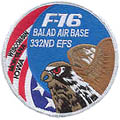
| Balad AB, Iraq (January 13th, 2008 to May 23rd, 2008) | |
| Deployed with just over 300 members. This was the first time the squadron did a full tour in South East Asia. A rainbow deployment with the 124th FS and the 186th FS as part of AEF1/2 (Cycle 7). | |
|
|
' Iraqi Freedom' |
| Balad AB, Iraq (September 9th, 2009 to November 12th, 2009) | |
| This marked the third consequitive deployment of the squadron into Iraq. |
F-16 Airframe Inventory
- All 176 FS F-16s in our F-16 Aircraft Database (past and current aircraft)
- Current 176 FS F-16s in our F-16 Aircraft Database
Photos
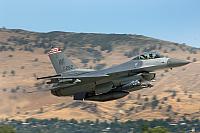
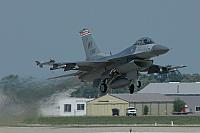
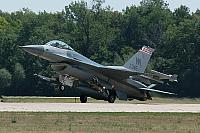

Please use this form to add any list any error or omissions you find in the above text.
Note: your comments will be displayed immediately on this page. If you wish to send a private comment to the webmasters, please use the Contact Us link.