
 |
Eskadrille 730 ( RDAF)" Birdsong" |
 |
Esk 730 " Birdsong" ( RDAF) | |||
| Status: |
Active
|
|||
| Version: | F-16A/B block 20 MLU | |||
| Role: | Multirole, Reconnaissance | |||
| Tailband: | N/A | |||
| Motto: | Vis Superne (Force from Above) | |||
| Badge: | A gray bison on a blue shield. | |||
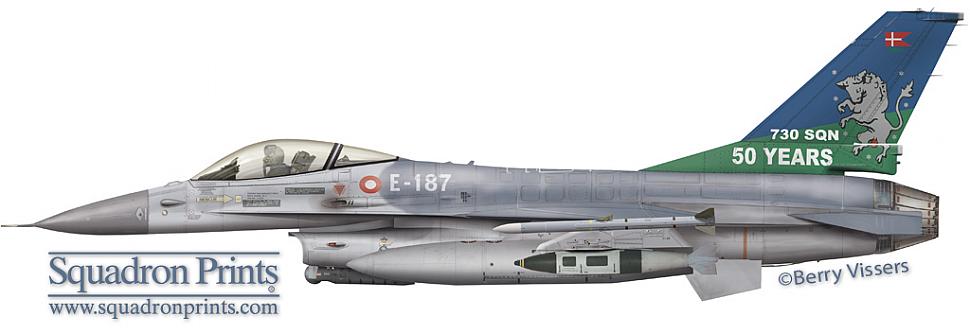
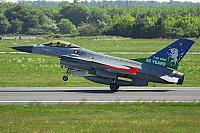
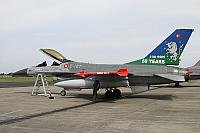
Sideways profile for Esk 730 in 2004 with the 50 years anniversary scheme.
F-16 History
Esk 730 was the second unit to receive the F-16 in the Danish air force. It too (as Esk 727) replaced the F-100 Super Sabre aircraft. The squadron was tasked with an air defense mission as backup to the Aalborg AB bases units.
First deliveries to the unit compromised block 10 versions of the F-16 fighter. They remained the mainstay of the fleet during the late eighties and early nineties. What makes the F-16 such a success is that the Multi Stage Improvement Program (MSIP) implements new features on existing airframes during the career of the aircraft. Denmark is the only country of the four EPAF countries that retained a number of F-16s who, despite being upgraded with later block 15 avionics, kept their small block 10 stabilizer. The other countries fazed out those older types after the Cold War, or upgraded them to full block 15 airframes with the larger stabilizer.
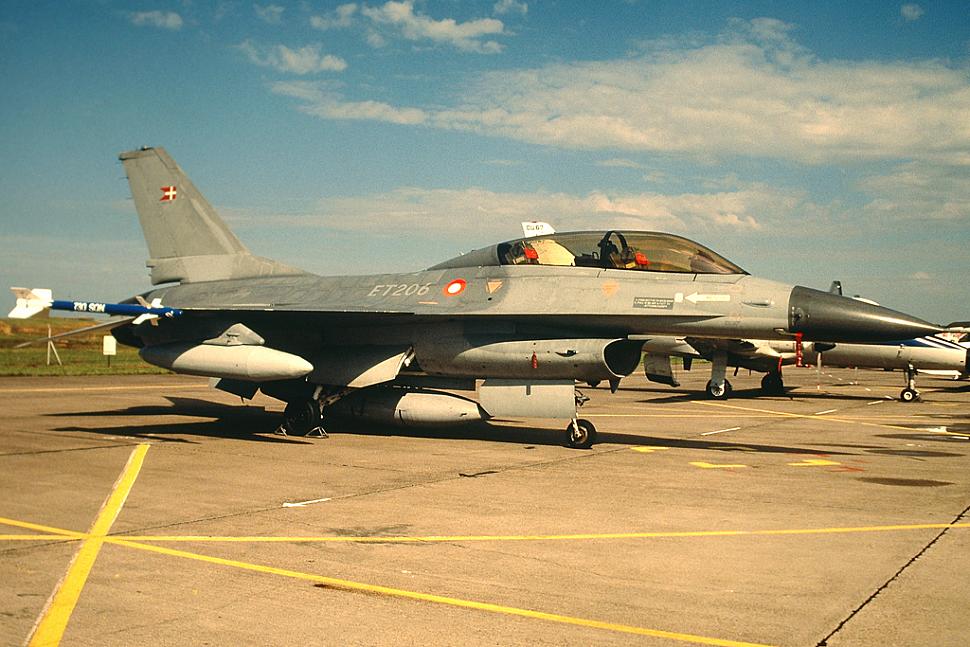
With the introduction of the MLU version, the possibilities of the F-16 gained dramatically. For the air defense units the addition of the AIM-120 missile was very welcome. The Danish are the only ones who updated those small stab airframes with the MLU package. Although these airframes are capable of carrying air-to-ground ordnance, they will seldom do since the center of gravity for these aircraft isn’t the same as with the larger stab installed.
After the disbandment of Esk 726 in 2005, the squadron also received that unit’s reconnaissance task. For this it uses the Terma (former Per Udsen company) Modular Reconnaissance Pod (MRP). Since that disbandment the squadron has around 25 F-16s at its disposal because the RDAF only retained two flying F-16 squadrons, both based at Skrydstrup AB, making that the sole F-16 base.
Aircraft Markings History
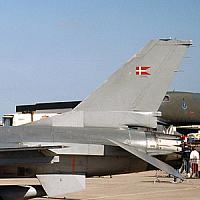
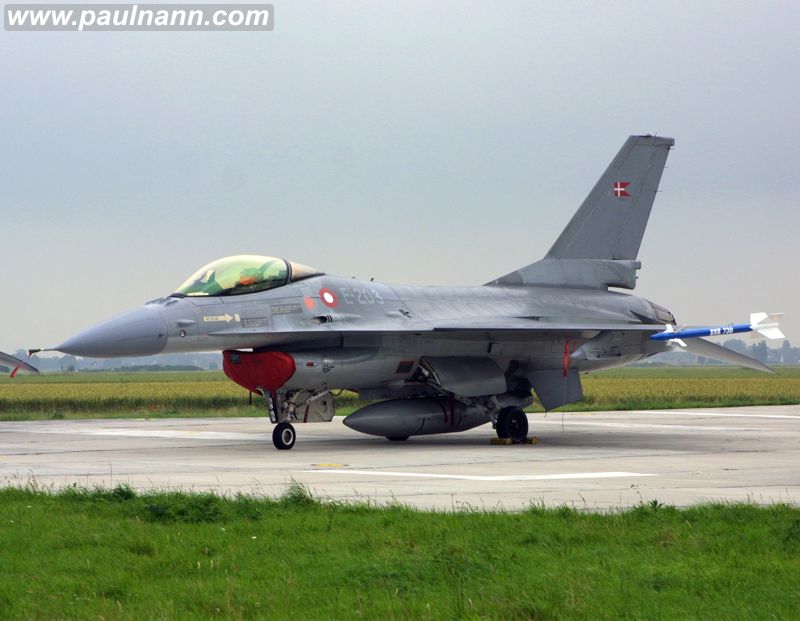
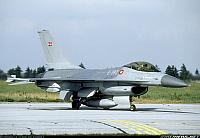
The Danish squadrons have never worn specific unit markings, except for temporary occasions. The tail markings consist of only a Danish flag in the middle. Unit markings are much more commonly found on the engine air intake.
Unit History
- 1954: Activation of the squadron in Karup
- 1954: F-84G 'Thunderjet' (Skrydstrup)
- 1959: F-84G 'Thunderjet' (Karup)
- 1961: F-100D/F 'Super Sabre' (Skrydstrup)
- 1982: F-16A 'Fighting Falcon'
- 2001: F-16AM 'Fighting Falcon'
Deployments
 |
' Allied Force' |
| Grazzanise AB, Italy (March 23rd, 1999 to June 10th, 1999) | |
| Operation 'Allied Force' was the codename for the almost three month long air strikes against Serbia. It was the first time after WWII that Denmark deployed fighters into operation. The aircraft were tasked with CAP mission since they didn’t send their new MLU aircraft. | |
 |
' Enduring Freedom' |
| Manas AB, Kyrgyzstan (October 1st, 2002 to September 30th, 2003) | |
| Operation 'Enduring Freedom' was initiated after the 9/11 attacks on the US. In Afghanistan this operation is aimed at fighting the remains of the Taliban which are still present in-country. | |
 |
' Air Policing Baltic States' |
| Siauliai AB, Lithuania (July 1st, 2004 to October 29th, 2004) | |
| This operation started when Lithuania, Estonia and Latvia joined NATO. These countries don't have fighters themselves and rely upon NATO for there air coverage. In a three-month rotation, Belgian, Danish, Norwegian and Dutch F-16s will patrol the skies over the Baltic States. | |
 |
' Air Policing Baltic States' |
| Siauliai AB, Lithuania (January 2nd, 2009 to April 30th, 2009) | |
| This is the second deployment of Danish F-16s to the Baltic. This operation started when Lithuania, Estonia and Latvia joined NATO. These countries don't have fighters themselves and rely upon NATO for there air coverage. | |
 |
' Iceland Air Policing and Surveillance' |
| Keflavik AB, Iceland (March 9th, 2009 to April 1st, 2009) | |
| After the USAF left Keflavik in September of 2006, they left a gap in Icelandic air defence. Since Russia resumed their long-range bomberflights, Iceland asked NATO to step in to fill this gap. Different NATO countries will rotate in and out of Keflavik to perform these air patrols. | |
|
|
' Iceland Air Policing and Surveillance' |
| Keflavik AB, Iceland (March 8th, 2010 to March 29th, 2010) | |
| For the second censequitive year the RDAF takes responsibility to cover the airspace of Iceland. This time the deployment was for only 3 weeks. | |
 |
' Odyssey Dawn / Unified Protector' |
| Sigonella AB, Italy (March 23rd, 2011 to October 31st, 2011) | |
| Denmark assigned a total of 6 F-16s to this campaign right after the start on March 23rd. | |
 |
' Air Policing Baltic States' |
| Siauliai AB, Lithuania (September 2nd, 2011 to January 3rd, 2012) | |
| This marks the third deployment of Danish F-16s to the Baltic. This operation started when Lithuania, Estonia and Latvia joined NATO. These countries don't have fighters themselves and rely upon NATO for there air coverage. | |
|
|
' Air Policing Baltic States' |
| Siauliai AB, Lithuania (January 3rd, 2013 to April 29th, 2013) | |
| Another round of policing the Baltic States was inserted in the Danish rotational cycle. | |
|
|
' Air Policing Baltic States' |
| Ämari AB, Estonia (April 28th, 2014 to August 31st, 2014) | |
| With the hightened tensions in Ukrain, NATO decided to also beef up its presence in some other areas close to the Russian or Ukrainian border. This led to some nations deploying fighters to the Baltics simultaniously and in higher number than normal. This is the first deployment to Ämari AB in Estonia. |
F-16 Airframe Inventory
- All Esk 730 F-16s in our F-16 Aircraft Database (past and current aircraft)
- Current Esk 730 F-16s in our F-16 Aircraft Database
Photos

Special Thanks
Martin / Viperviking
Sources
http://www.ole-nikolajsen.com/RDAF%20history/d-Flyvevabnet.htm
Please use this form to add any list any error or omissions you find in the above text.
Note: your comments will be displayed immediately on this page. If you wish to send a private comment to the webmasters, please use the Contact Us link.